

May 19, 2026
The quick version
- Luxury home lighting isn’t about how many fixtures you install. It’s about placing the right light in the right spot at the right time.
- A well-designed lighting scheme layers three types: ambient (the base glow), task (focused, functional light), and accent or feature lighting (the character).
- Lighting decisions need to happen during the design stage, not at the electrical rough-in. Late planning limits wiring options and fixture placement.
- Warm white light suits living and sleeping zones. Kitchens and bathrooms benefit from a slightly cooler, crisper tone. Mixing temperatures carelessly across open-plan spaces creates visual dissonance.
- A room lit entirely by recessed downlights will feel flat regardless of how much you’ve spent on finishes. Layers and dimmers are what give a home atmosphere.
- In Perth, where indoor-outdoor living is central to how homes function, lighting needs to transition confidently between interior spaces and exposed exterior zones.
You’ve invested months into choosing the right flooring, agonised over stone and timber finishes, and locked in a colour palette you’re genuinely proud of. Then you move in, flick the lights on, and something feels off. The marble bench looks grey instead of warm. The open-plan living zone reads as one flat expanse.
The problem usually isn’t the finishes. It’s the lighting.
Luxury home lighting is one of those decisions that quietly shapes everything else in a custom home. Get it right and the whole interior clicks: materials look the way they’re supposed to, rooms shift mood throughout the day, and every zone feels purposeful. Get it wrong, and even the most considered finishes can feel flat.
It’s a balance that interior designer Nicola Draper-Henkel regularly helps clients navigate during the selections process, and one that influences how lighting is considered from the outset.
Why lighting belongs in the design stage
Clients will spend weeks deliberating over cabinet handles and benchtop edges, then leave lighting as one of the last items ticked off. Nicola sees it all the time. “Lighting can often be an afterthought,” she says. “There are just so many decisions with a new build, and it’s probably a long way down the list for most people.” That’s why at Stannard Homes, this is addressed much earlier in the design process, with lighting considered alongside floor plans and key material selections rather than left to the end.
The issue is that lighting affects how every other decision actually performs once you’re living in the space. A natural stone benchtop chosen for its warm veining can look washed out under the wrong colour temperature. Textured plaster that’s meant to catch raked afternoon light loses all its depth if the only fixtures in the room are flat recessed downlights aimed straight down.
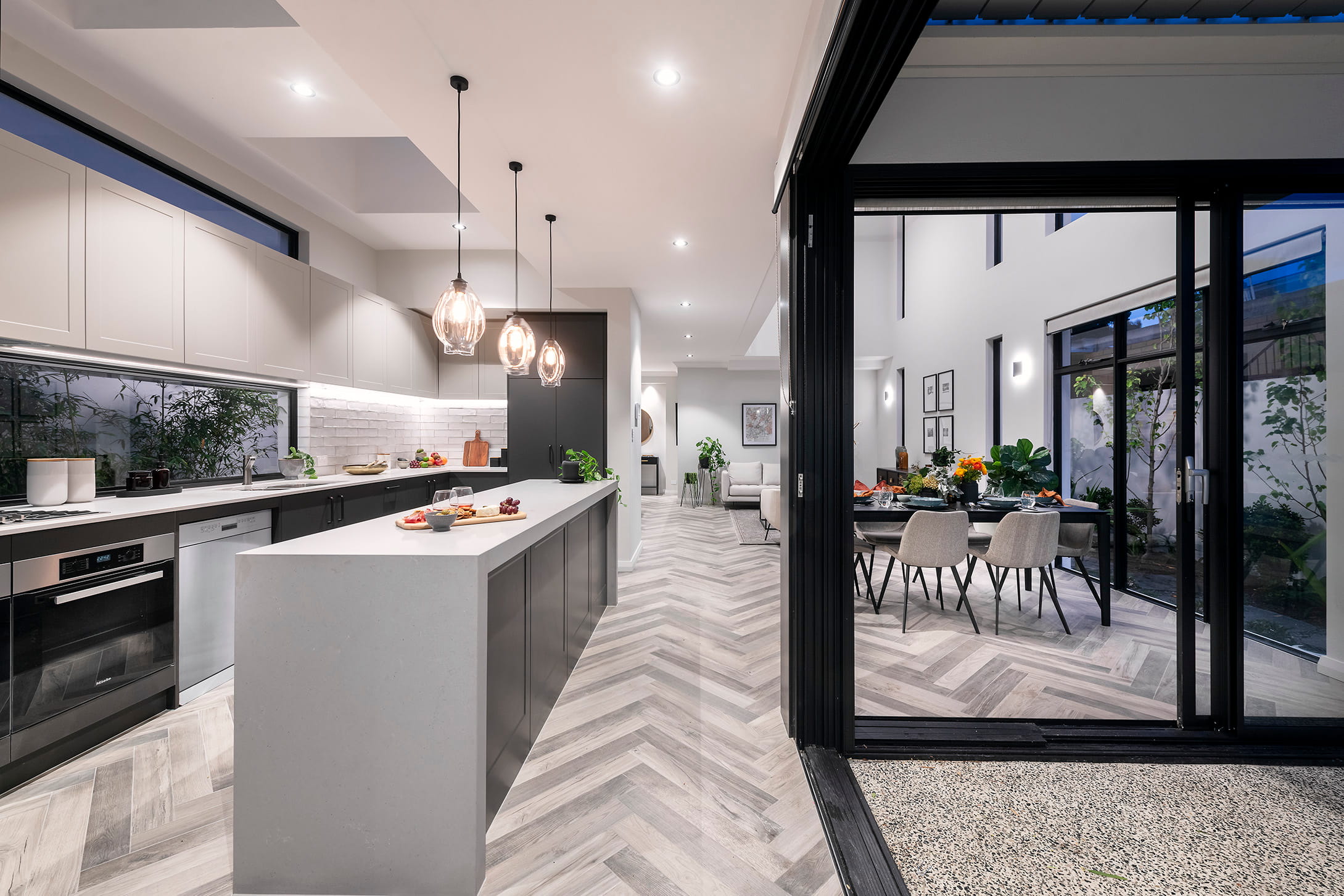
Late lighting planning is often one of the biggest design pitfalls in residential construction, because it leads to poorly placed fixtures and severely limited wiring options. It’s easy to see why when you think through the practicalities. Under-cabinet LEDs need wiring concealed behind cabinetry. Pendant lights over an island need a junction box at the exact right ceiling point. Cove lighting along a ceiling recess needs to be designed into the plaster profile before it’s built. None of these can be easily retrofitted once walls are lined, and improvising after the fact almost always shows.
 Three layers, one system
Walk into a room that feels genuinely considered, the kind where you exhale slightly without knowing why, and the lighting is almost certainly doing more than you realise. It won’t be a single source. It’ll be several, working at different intensities, from different heights, each one doing a specific job. It’s an approach applied across Stannard homes, where lighting is layered deliberately to support how each space is used throughout the day.
As Nicola puts it, “In luxury homes, we always want that beautiful layered effect. Multiple lighting options help achieve that.”
Ambient lighting
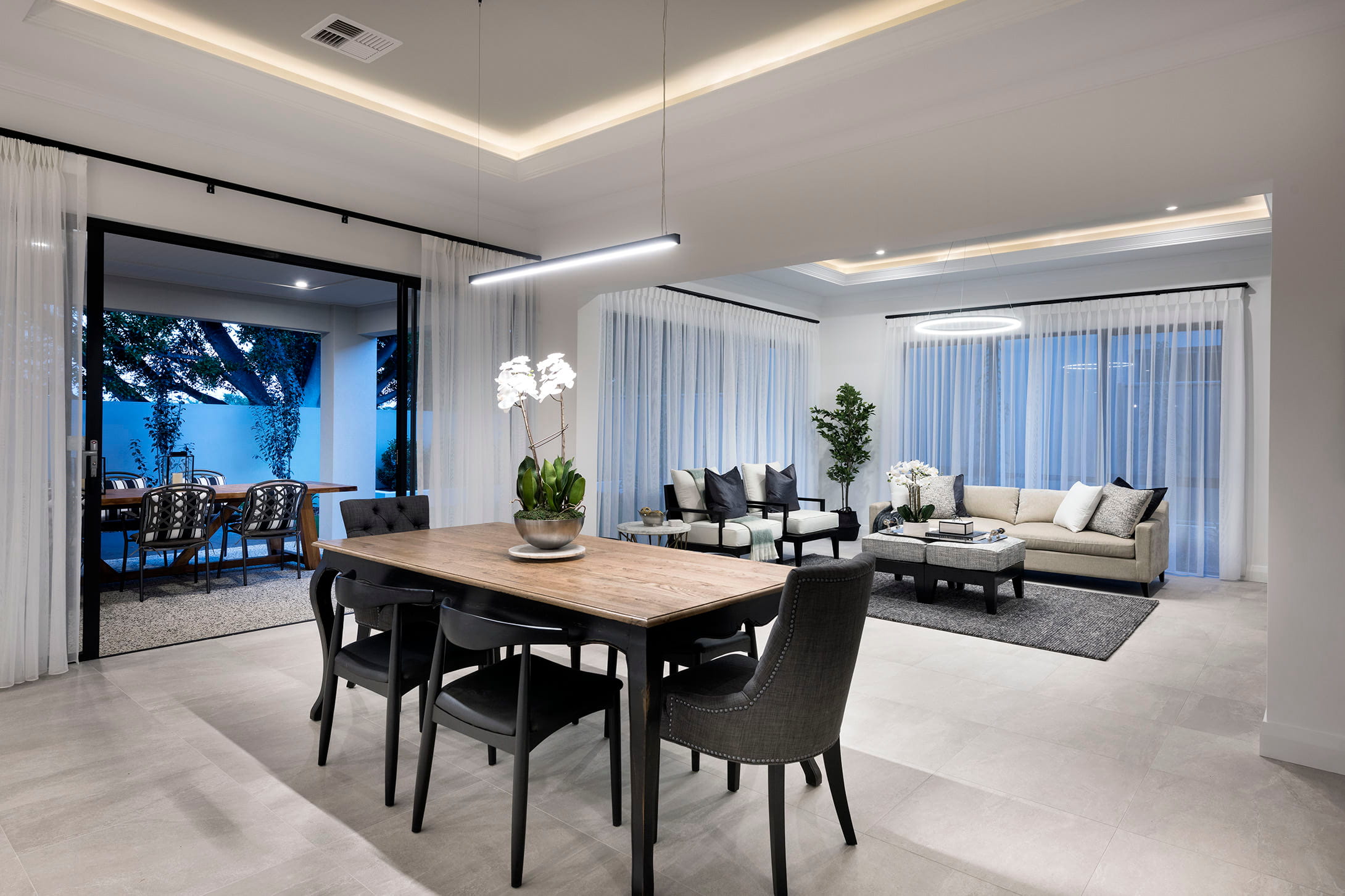
Ambient light is the foundation: the soft, even base that lets you move through a room and sets its overall tone. Recessed downlights, cove lighting, and indirect ceiling washes all serve this purpose.
On its own, though, it’s flat. A room lit solely by a grid of downlights will feel evenly bright but lack warmth or visual interest, no matter what’s on the walls or underfoot. Ambient light is the canvas that needs other layers over it to feel complete; layered lighting is now a defining feature of well-designed Australian homes rather than an optional upgrade.
Task lighting
Task lighting provides focused illumination for the things you actually do in a room: cooking, reading, applying makeup, working at a desk. Pendants over a kitchen island, under-cabinet LEDs on a benchtop, a floor lamp angled beside an armchair.
It also plays a spatial role. In an open-plan layout, a line of pendants over the island immediately signals where the kitchen begins without needing a wall.
Nicola’s approach here is measured rather than maximal: “Just a few strategically placed pendants. You might have three over a kitchen island, or one linear pendant over an island, or a beautiful pendant feature in a stairwell void.” You don’t need a fixture on every surface. A few well-chosen task lights, placed with intention, will always outperform a dozen placed without it. This is something clients are often guided through during the selections process, focusing on a few well-placed fixtures rather than over-lighting the space.
Feature and accent lighting
This is the layer where a home starts to feel like yours. Wall lights flanking a piece of art in the entryway. A sculptural pendant suspended in a double-height void. Concealed LEDs washing light down a textured stone wall.
Accent lighting works by contrast. For a feature to register as a focal point rather than just another lit surface, it typically needs to be noticeably brighter than the surrounding ambient light. In luxury settings where you want genuine drama, designers will often push that contrast further to create a stronger sense of depth and focus.
Colour rendering matters here too. LEDs with a Colour Rendering Index (CRI) of 90 or above ensure that premium materials like natural oak, marble, and stone display their true tones. A lower CRI can make those same finishes look dull or slightly off, which defeats the point of having invested in them.
For fixtures themselves, Nicola gravitates toward natural materials: “There’s a beautiful range of lights available at the moment in alabaster. Because they’re a natural material, they’ve got that timeless feel to them.” She also notes that “wall lights generally have become a lot more prominent in recent years,” and uses them regularly to build dimension without overcomplicating a scheme.
Lighting that reveals texture and detail
A Venetian plastered or stone-clad wall, or hand-finished timber panelling in the study. These are materials chosen for their texture, but without the right light, that texture disappears.
Two techniques make the difference. Grazer lighting places a fixture close to a surface and directs light along it at a shallow angle, exaggerating every ridge and groove. It’s ideal for masonry, rustic brick, and heavily textured stone. Wall washing does the opposite: fixtures sit further back from the surface, typically around a third of the room’s ceiling height, casting a broad, even distribution that suits smoother finishes where you want the material’s character without overemphasising every imperfection.
Concealed linear LEDs can also trace structural contours, running inside ceiling recesses or along exposed beams to bring the bones of a room to life with a soft, indirect glow. You don’t notice these consciously. You just feel that the room has depth.
Nicola describes it in practical terms: “A beautiful light above, or two wall lights beside a piece of prominent art in an entryway. They’re just really simple ways of adding dimension and creating atmosphere.”
Defining zones in open-plan living
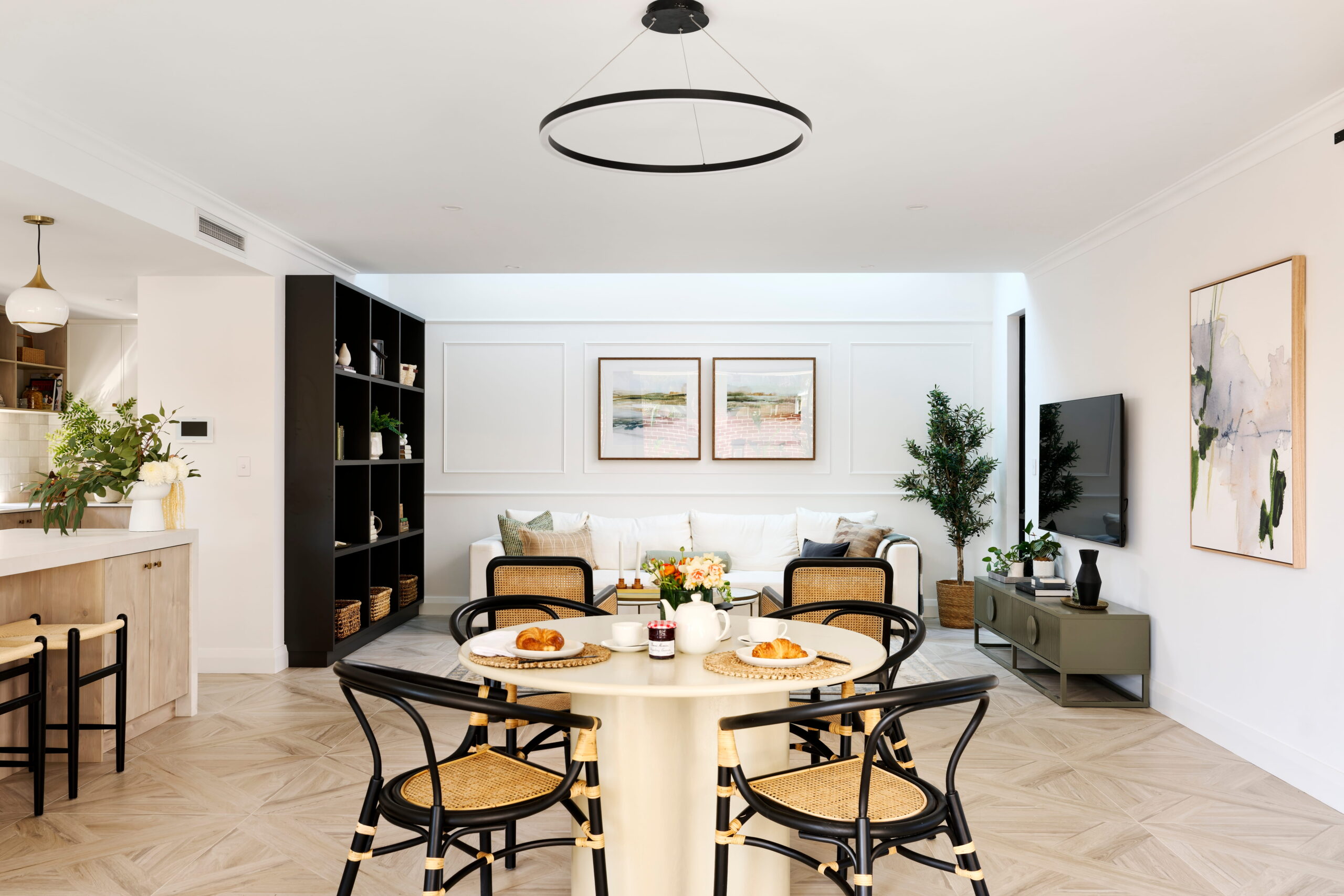
Picture a Saturday night. You’re finishing dinner prep at the island, the kids are watching a film in the living zone, and the dining table is set for guests arriving in twenty minutes. Each of those moments calls for a completely different quality of light, and they’re all happening in the same room. Across Stannard Homes projects, this kind of layered zoning is considered from the outset, helping each area function independently while still feeling connected as part of a larger space.
That’s the challenge of open-plan living, and it’s one Nicola is direct about: “With open-plan spaces, lighting strategy is really important, and placement is incredibly important too.”
She starts with the practical base. “I always would recommend some amount of downlights for that space. Always on dimmers.” Then the layers build outward. “Maybe a couple of pendant lights and definitely some floor lighting. A floor lamp in the one corner, a table lamp on a buffet, potentially. And they can all work together or individually.”
That final detail matters more than it sounds. The goal isn’t to have every light on simultaneously. It’s to have enough independent sources that you can light each zone differently: kitchen bright for prep, dining dimmed for dinner, living zone glowing with nothing but a floor lamp and the soft wash from an accent light on the bookshelf.
Getting colour temperature right
You can place every fixture perfectly and still end up with rooms that feel cold, clinical, or strangely disconnected from each other. Colour temperature is usually the culprit.
Nicola doesn’t waver on her preference: “I’m a real fan of using a warm white light. Cool whites to me feel a little bit clinical, bit hospital-like. I’m always checking that the globes we put into all our lights are the warm variety.”
One trap to watch in open-plan layouts is mixing different colour temperatures across the same sightline. If the kitchen pendants are cooler and the living room downlights run warmer, the transition jars rather than flows. Keeping your main ambient fixtures at a consistent temperature and reserving slightly cooler tones for dedicated task lights avoids the tonal clash.
The science supports the warm approach too. Research published in the Journal of Applied Physiology found that blue-spectrum light suppresses melatonin production and disrupts sleep quality, a finding echoed by Harvard Health. Warm bedside lighting isn’t just an aesthetic choice; it’s a practical one that supports your body’s natural rhythms. For rooms that serve multiple purposes throughout the day, tunable smart LEDs that shift from cooler daytime tones to warmer evening settings offer genuine flexibility without compromising either end.
The mistakes that flatten a new build
Here’s the frustrating part. You can invest in beautiful finishes, considered floor plans, and premium materials, and still end up with rooms that feel oddly lifeless. Not because anything’s wrong, exactly, but because the lighting was never given the same level of thought as everything else.
Nicola identifies the biggest culprit without hesitation: “The main lighting mistakes would be an overload of downlights, essentially, and just not really much of anything else. And that just can feel quite flat.”
Common mistakes along similar lines include: skipping dimmers (which locks every room into one brightness), choosing the wrong colour temperature for a room’s purpose, not balancing artificial light with the natural light already entering through windows, and leaving lighting decisions too late in the build when wiring options have narrowed.
The Australian Government’s YourHome.gov.au resource integrates lighting into overall home design planning from the outset and recommends high-CRI LEDs for any residential environment where colour accuracy matters. For Perth homes specifically, where strong natural light pours through large windows for most of the year, your artificial lighting needs to complement that daylight rather than compete with it, stepping up gradually as evening falls.
Every one of these mistakes is avoidable. They just require lighting to be part of the design conversation from day one.
How Stannard Homes designs lighting into every build
In a custom home, lighting decisions intersect with floor plans, ceiling profiles, cabinetry, and electrical layouts. Getting them right requires the design team, the interior designer, the selections consultant, and the electrical team all working from the same set of plans at the same time.
That’s the advantage of having every department under one roof. At Stannard Homes, lighting isn’t treated as a standalone item handed off to an external consultant. It’s woven into the broader design process from the floor plan stage, so wiring is mapped alongside layout decisions, pendant positions are locked in before ceilings are lined, and under-cabinet lighting is part of the cabinetry design from the beginning.
Every client works with interior designer Nicola Draper-Henkel as part of the standard build process. During a dedicated selections session at Design Home on Churchill in Subiaco, Nicola guides clients through the initial direction of the home, establishing the colour palette, mood, and key material selections such as flooring, cabinetry, benchtops, and tiles.
From there, the process moves into more detailed selections with Lee, the client selections and finishes consultant, who works closely with clients to carry that direction through into elements like lighting, tapware, cabinetry profiles, doors, and paint, ensuring everything remains cohesive.
Nicola’s approach centres on reducing overwhelm. Rather than presenting a catalogue of hundreds of options, she curates a focused shortlist tailored to each client’s style and builds outward from there. “It’s not a lot,” she says. “You don’t have to spend a fortune. It’s just about getting the selections right and getting them right early on.”
With every detail coordinated across the team, selections flow clearly from design through to construction, so nothing gets lost between the showroom and the site. It’s a process refined across 65 years of building custom homes in Perth, and one of the reasons clients consistently describe the experience as more enjoyable than they expected.
Light is what brings a home to life
Every surface, every material, every carefully chosen finish in a luxury home depends on light to do its job. A marble benchtop needs warm illumination to show its veining. A textured wall needs raked light to reveal its depth. An open-plan living zone needs layers and dimmers to shift from morning energy to evening calm.
Luxury home lighting isn’t about filling rooms with brightness. It’s about control, contrast, and knowing that a handful of well-placed fixtures can do more for a space than fifty downlights ever will.
If you’re ready to start the conversation about your next home, get in touch with the Stannard Homes team.
Frequently asked questions
1. What is the best lighting for a luxury home?
A layered scheme combining ambient, task, and feature lighting gives you the most flexibility and atmosphere. Warm white LEDs with a CRI of 90 or above ensure your materials look their best, and dimmers on every circuit let you adjust the mood throughout the day.
2. How many layers of lighting does a room need?
Three at minimum: ambient for the base glow, task for focused activities, and accent or feature lighting to highlight focal points. In larger or open-plan rooms, a fourth decorative layer with statement fixtures adds personality and visual anchoring.
3. What colour temperature works best for living rooms?
Warm white suits living rooms and bedrooms. It produces a relaxed, inviting atmosphere without the clinical edge of cooler tones. Kitchens and bathrooms benefit from a slightly crisper option for task clarity.
4. When should lighting be planned in a new build?
During the initial design stage, before electrical rough-in. Early planning ensures wiring, circuits, and fixture positions are integrated into the home’s structure rather than retrofitted around it. Late decisions almost always lead to compromises.
5. What are the most common lighting mistakes in new homes?
Over-relying on recessed downlights, skipping dimmers, choosing the wrong colour temperature, and leaving lighting decisions too late in the build. All four are avoidable with early planning and guidance from an experienced design team.


